

Table of Contents
- What Is a Multifamily Fund?
- How a Multifamily Fund Actually Works
- The Human Side: Why People Really Invest in Multifamily Funds
- Types of Multifamily Funds (And Which One Fits You)
- The Real Advantages of a Multifamily Fund
- But… What Are the Real Risks? (Let’s Talk Honestly)
- How to Choose a Good Multifamily Fund (The Questions I Ask)
- A Simple Example to Visualize a Multifamily Fund
- Personal Reflection: Why I Believe in Multifamily Funds
- Is This Path for You?
If you landed here because you’re trying to understand what a multifamily fund is —and whether it’s actually worth it— let me tell you something: I get you. I went through that same journey. And yes, it was filled with doubts, endless Google tabs, and that weird feeling of “Am I making a smart move or about to make an expensive mistake?”
But here’s the good part: once you truly understand how a multifamily fund works, the pieces start to fall into place. Suddenly, you can see beyond the acronyms, the projections, and the performance charts.
And today, I want to walk you through that process, as if we were having coffee and you told me:
“Explain this to me without the jargon, but without dumbing it down.”
Let’s get into it.
What Is a Multifamily Fund?

A multifamily fund is basically a vehicle that pools money from multiple investors to buy apartment buildings. Not a duplex, not a triplex… entire buildings or portfolios of properties.
The advantage?
You don’t have to be the owner-operator chasing a tenant who didn’t pay rent. I’ve been in that movie… would not recommend it.
A professional operator manages the fund: they find opportunities, analyze the numbers, manage the properties, negotiate financing, execute improvements, and eventually sell.
You just receive the benefits according to your share.
But let me ask you a quick question to break the ice:
Would you rather own one single building… or a diversified slice of several?
That’s where these funds shine.
How a Multifamily Fund Actually Works

The Full Multifamily Fund Cycle
Even though every company has its own style, most follow this sequence:
1. They raise capital
Investors—often accredited—commit money. Yes, “commit” sounds serious. It is.
2. They buy multifamily properties
Funds may follow very different strategies:
- Core (low risk)
- Core-plus
- Value-add (my favorite—you’ll see why)
- Opportunistic (high adrenaline)
3. They manage and improve the assets
From light renovations to full complex transformations.
4. They generate rents and cash flow
Tenants pay, and that flow is part of what you receive as an investor.
5. They sell the assets
Ideally when the market is hot or after value has been created.
6. They repay investors with profits
Up to here, it all sounds logical. But here comes what almost nobody tells you.
The Human Side: Why People Really Invest in Multifamily Funds

Let me share an uncomfortable truth:
Most people don’t invest just for the numbers.
We invest for peace of mind, for diversification, to stop living tied to a job, to feel part of something bigger.
And a well-chosen multifamily fund can give you exactly that:
- passive income without stress,
- capital appreciation,
- tax benefits,
- and access to institutional-level real estate.
Do you know what convinced me the most the first time?
The feeling that my money didn’t depend on a single tenant, but on hundreds.
Types of Multifamily Funds (And Which One Fits You)
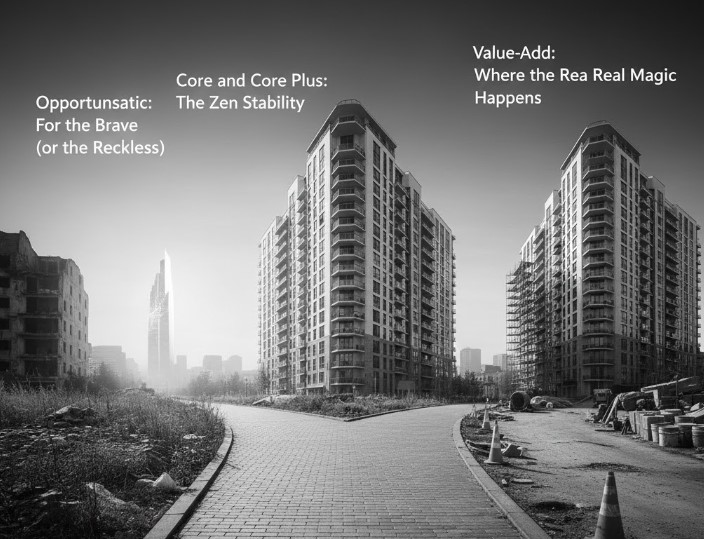
Core and Core Plus: The Zen Stability
If you’re the type who sleeps better when everything is stable, these might be for you.
High-quality buildings, premium areas, reliable tenants.
Moderate returns. Low drama.
Value-Add: Where the Real Magic Happens
This is where I usually say:
“This is where the magic is.”
These buildings need improvements—painting, upgrading kitchens, updating amenities, better management…
All those details increase rents, reduce vacancy, and boost NOI.
I’ve seen buildings go up 20% to 40% in value after a solid value-add execution.
The risk? Yes, it exists. But it’s manageable with the right operator.
Opportunistic: For the Brave (or the Reckless)
Ground-up development, heavily distressed properties, emerging markets.
Huge potential returns… or not.
I invested in a deal like this once. The result?
Great profits, sky-high stress.
Wouldn’t repeat it without an ultra-experienced operator.
The Real Advantages of a Multifamily Fund

Automatic Diversification
Instead of betting everything on one property, your capital is spread across several.
One building has a rough year?
The others balance it out.
Professional Management
You literally pay so you don’t deal with problems.
And trust me, there are problems Excel does not warn you about.
Institutional Scale
An individual can’t buy a $40M building, but a fund can.
And you can own a piece of it.
Tax Benefits
Accelerated depreciation, deductions, and in some cases advanced tax strategies.
Not every country offers the same, but in the U.S. it’s powerful.
But… What Are the Real Risks? (Let’s Talk Honestly)

Low Liquidity
You can’t just “pull out” whenever you want.
Funds have fixed timelines: typically 5 to 10 years.
Operator Dependency
If the sponsor is excellent: everything flows.
If they’re mediocre… you’re in trouble.
I say this because it happened to me:
I invested in a fund whose team seemed solid. Later I discovered they had no real value-add experience.
Result: delays, poor execution, returns below projections.
Lesson learned?
The sponsor matters more than the property.
Market and Interest Rates
Interest rate hikes, rent declines, recession—these can all affect returns.
Fees
Some funds charge fees that can eat into your returns.
Yes, you have to read the fine print.
How to Choose a Good Multifamily Fund (The Questions I Ask)

If you were standing in front of a sponsor today, here’s what I’d tell you to ask:
1. What’s your track record?
Not in PowerPoints. In real numbers.
2. What is the fund’s exact strategy?
Core is not Value-Add.
Don’t invest without understanding the risk profile.
3. Where are you buying?
I look for markets with:
- population growth,
- job creation,
- low housing supply,
- strong rental demand.
4. How exactly will you create value?
The how separates amateurs from pros.
5. What are the total fees?
Some look small… but they add up.
A Simple Example to Visualize a Multifamily Fund
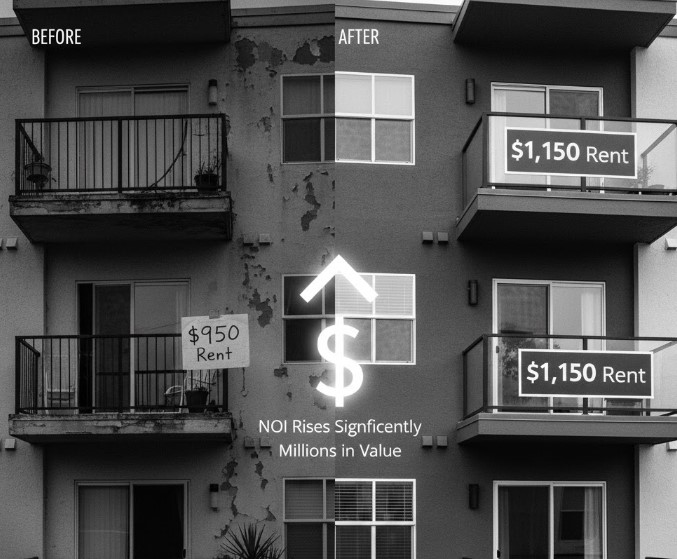
Imagine this:
- The fund buys a 120-unit building.
- Current average rent: $950.
- Market rent: $1,150.
- Renovation cost per unit: $4,000.
- Post value-add vacancy drops 2%.
- NOI rises significantly.
- Property is refinanced or sold after 5–7 years, returning capital + profits.
That $200 rent bump (which sounds tiny) can generate hundreds of thousands in annual NOI and millions in property value.
That’s the heart of the model.
Personal Reflection: Why I Believe in Multifamily Funds
I won’t romanticize it:
Investing in a multifamily fund won’t make you rich overnight.
But it does give you something powerful:
A chance to participate in a solid, necessary, stable industry—without the operational burden that burns out solo property owners.
For me, the decision had an emotional component:
I knew I wanted passive income, but I also wanted peace.
And when I found the type of fund that fit my goals, I felt something close to breathing wider.
Is This Path for You?

Ask yourself:
- Do you want real passive income?
- Do you want diversification without managing buildings?
- Are you okay with a multi-year commitment?
- Are you comfortable trusting an operator?
- Do you have moderate risk tolerance?
If you answered “yes” to several… then a multifamily fund might deserve your attention.
And if not, that’s fine. Not every investment is for everyone.
But if your intuition says “I think this might be for me…”
Maybe it’s time to analyze your first fund like a professional—
with a cool head, a steady heart, and a touch of human intuition.